“Of course you and She Who Must Be Obeyed enjoyed the dinner at St. John, but what about He Who May not Be Ignored?” I hear you ask. “What did a ten-year-old boy think of such a sophisticated meal?”
Fortunately, the stark dining room worked in our favor. Miles was relaxed and comfortable, and he even got up a few times to walk around in the downstairs bar/bakery area.
The food wasn’t completely foreign to him, especially the crispy pig skin, since he had dined on the previously alluded to Best Pig Ever with us. He was the only child in the dining room, which didn’t escape the notice of some of the other diners. As were were leaving, a gentleman at the table next to us asked us “Did your son enjoy the meal?”
“You can ask him yourself,” I replied.
“Did you like the food?” he asked Miles.
Miles gave two thumbs up: “It was awesome!”
“What did you like the most?”
“The crunchy pig skin and the bone marrow on toast!”
As we left I told Diane “That’s the basis for an argument at that fellow’s home. Sometime soon at his dinner table he’ll be scolding one of his children: ‘I watched a ten-year-old American boy eat pig skin and bone marrow, and you won’t even eat your peas!'”
In 2001 the Food Network aired A Cook’s Tour, a food and travel show hosted by Anthony Bourdain. He traveled around the world eating the local food, and I hung on every bite. Of the many remarkable meals he ate in the series, this one was burned into my brain (The series remains criminally unreleased on DVD; this excerpt is extracted from the Belm Laboratoriesâ„¢ TiVo Archive.):
As soon as we confirmed the details of our London trip I hit the St. John web site to make a reservation for the three of us — I would not be cheated out of the chance to eat there. I bookmarked the menu page, then checked it obsessively in the days leading up to our departure. It changes every day, all but one item.
After a day spent at the Tower of London, we returned to our hotel, then took a cab to Clerkenwell, near the Smithfield meat market — from one abbatoir in the morning to another in the evening. The cabbie dropped us off and pointed to a nondescript door in a short alleyway. This was the place, although you’d hardly notice it during the day.
The restaurant is stark, whitewashed walls, simple wooden chairs and tables with white linens, and absolutely nothing else: no music, no artwork, nothing that would detract from the food. We were seated and handed the menu, printed on a single sheet of paper. On to the meal:
Starters:
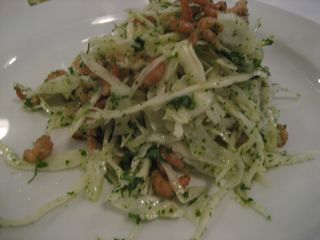
Brown Shrimp & White Cabbage
Exactly as described (which would be true for each menu item): cooked baby shrimp tossed with a slaw made of cabbage and minced parsley, lightly dressed with oil, lemon juice, and a touch of mustard. The dish was very light and refreshing, the crunchy slaw contrasting perfectly with the soft, sweet shrimp.
Crispy Pig’s Skin & Watercress
This was a similarly dressed watercress salad with a few whole roasted shallots, topped with crispy fried pig skin “croutons.” These were the best pork rinds (call a spade a spade) I’ll ever eat, greaseless and so crispy they shattered when you bit into them. Another study in contrasts, this time the acidity in the salad balancing the bitter watercress and the sweet shallot.
Roast Bone Marrow & Parsley Salad
This is the dish that put chef Fergus Henderson on the map. It’s Bourdain’s (and now my) death row meal, what he describes as “God’s butter.” It’s not the first roast bone marrow I’ve eaten, but it is unquestionably the best. As soon as our waiter handed me the marrow spoon, I set to work, scooping out marrow and spreading it on the grilled sourdough bread, garnishing it with the accompanying sel gris and parsley salad. I prepared slices for the three of us, who all had the same reaction: one bite, and a softly whispered “Oh!” If you like a bit of fat with your roast meat, this dish is the distilled essence of animal fat in a perfect delivery vehicle. Smooth, unctuous marrow, crunchy bread, grains of salt that burst when chewed, and another perfect little salad to provide just enough acidity to temper the mouthfeel of the marrow. A few capers mixed in with the salad added a surprising “green” top note – I wouldn’t have noticed it’s absence, but it belonged there.
Mains:
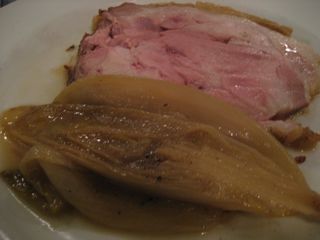
Roast Middlewhite & Chicory
Middlewhite is the breed of pig from which this slice of roast pork was cut. The preparation couldn’t be simpler: cook the pork roast exactly as you would cook beef prime rib, then serve it medium rare with some of the roasting jus. If I didn’t have access to locally grown pork, this dish would have been a revelation, instead it was merely a very good slice of meat. Again, contrasts, this time the bitter braised chicory playing against the sweetness of the pork.
Braised Rabbit, Bacon & Mustard
I had some reservations about ordering this since mustard can overwhelm a dish. I needn’t have worried in this case. The mustard was an accent in the braising liquid, providing a sharp note to counterpoint the smoky bacon and the gamy rabbit. The braised saddle and leg fell off the bone, perfectly cooked. A single braised shallot added some needed sweetness.
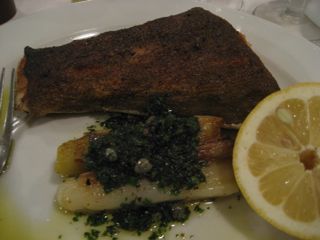
Halibut, Leeks & Green Sauce
The simplest dish we were served. Halibut, still on the bone, crusted with a simple spice rub (salt, pepper, paprika) and pan seared. It was accompanied by a few braised leeks; the “green sauce” was the braising liquid to which minced parsley and lemon had been added. Not much else needs to be said about a perfectly cooked piece of fish.
Sides
You must have noticed by now that the food is served straight up and ungarnished. Our waitress suggested some side dishes, so we chose the new potatoes and greens. We got roasted red potatoes with butter, salt, and parsley, and brasied cabbage and chard that retained a bit of crunch. Very simple, but the correct accompaniments to our dishes.
Wine
I was confounded by the all-European wine list, but found a nice Côtes du Rhône to go with the pig skin, marrow, pork, and rabbit.
Desserts:
Baked Chocolate Mousse & Creme Fraiche Ice Cream
A lovely, light mousse cake set against the surprisingly tangy ice cream. A winning combination.
Eccles Cake & Lancashire Cheese
We learned that an Eccles cake is a puff pastry shell filled with black currants and cinnamon sugar. Just as the mousse was offset by the ice cream, the sweetness of the cake played perfectly against the sharp farmhouse cheese. Diane loved this dessert so much that she has vowed to reproduce it at home.
Suckling pig:
On the back of the menu I saw “Suckling pig can be ordered one week in advance.” I had already investigated this possibility before arriving, but it was not to be — whole pig is available only to parties of ten or more. But that didn’t stop us from watching this beast being served to the table behind us.
If I hadn’t already eaten the Best Pig Ever elsewhere (subject of another post), I might have begged the fellows behind us for a nibble or two. Instead we watched the pig get carved up, with the head served to the birthday honoree. Lucky guy, he got the best part — the cheeks — without having to fight for it.
Final Impressions:
I’ve gone on long enough about this meal and how it tasted. I won’t forget that anytime soon, but what will stick with me for years is how that food was cooked and presented: simple preparations of the best possible ingredients with no distractions. At St. John it was — and will always be — all about the food.
Postscript
No blog post about St. John would be complete witout a mention of Nose to Tail at Home, which documcnts Ryan Adams’ effort to cook every recipe in Fergus Henderson’s magnum opus. Ryan graciously mentions this review in his blog; I urge you to check out his work.
While consulting a map of the London neighborhood near our hotel, I made an important discovery: we were a mere ten minute walk from one of the most famous landmarks in the history of pop music. So on Sunday morning, before traveling into the city for the day’s activities, we made a slight detour to document my find:
We were concerned that Miles would be either bored with or overwhelmed by the amount of information at the museum. As you can see, our fears were unfounded. Not a bad summary for a ten-year-old.
Our friend Gretchen, who has lived in London for 13 years, took us along for her weekend shopping trip to Borough Market, literally under London Bridge.
I feel quite lucky to live near the Union Square Farmer’s Market. It’s open on Saturdays from 9 AM to 3 PM, from June through November. It fills the small pedestrian plaza in the Square. Borough Market sprawls across at least two entire city blocks, is open all day every Thursday through Saturday, all year ’round.
I spent the morning sampling everything and buying a few things to snack on. Here’s a bit of what I saw.
Fresh tomatoes in April? Yes, when they're transported from Italy - a shorter distance than from California to Boston.
Fresh seafood, including real Dover sole.
Fresh baked bread was everywhere, mostly from organic bakeries.
Cured meats of every kind. At this stand I bought dry salami made from Basque pigs. I'll have to eat it all here, I can't transport it back into the States.
This coffee stand, one of two locations in the market, was so popular it had lines wrapping around the block. They make individual cups of drip filter coffee, pouring water into the funnels on top, letting it drip into cups below.
This is a 4' diameter pan of seafood paella, cooking away on a gas burner.
... and a similary sized pan of chicken paella.
Diver scallops in the shell, off the morning boat.
A whole monkfish.
There was much more, but you get the idea.
It’s probably just as well there isn’t a market like this near home, I’d drop a week’s salary there every month. Because all of this pefect food comes at a cost – a very steep cost. But if what I saw and tasted was any indication, it’s worth it.
The butcher, who might have a future as the world’s classiest crack dealer, offered me a slice to taste. Big mistake. One bite and I knew I was leaving with cold cuts that cost $113 per pound. He informed us that Harrods was the only store in Britain licensed to sell this particular ham. I replied that I was aware of that distinction and had traveled all the way from the States to buy a quarter pound of the world’s best ham. I had him going for about a minute.
We grabbed a loaf of fresh bread on the way out, planning to have ham and bread for breakfast.
And what a breakfast it was. Place a slice of this ham in your mouth and the fat just melts away, leaving an aftertaste of acorns and grass. The meat is air cured with minimal salting, so you taste concentrated pork but no smoke. A plain baguette was the perfect vehicle for the meat, adding texture but minimal extra flavor.
It’s very rich; we were both satisfied with just a few slices. That leaves enough for tomorrow’s breakfast before our trip to Borough Market by London Bridge. Stay tuned for that post as well as a dish-by-dish review of our dinner at St. John.
Yesterday was your tenth birthday, but it was ten years ago this morning that I first sang this song to you. The recording and lyrics are by Lambert, Hendricks, and Ross; the tune is by pianist Randy Weston, written for his son Niles. I took the liberty of changing one letter.
Little Miles, every little boy in one — and so much fun
Little Miles, half a man and half a child and when he
Smiles, like all children everywhere he really living truth,
For truth is part of youth, and when you feel contentment
Surround you, you know he’s around you
Little Miles, warms your heart and cheers your day in every way
Little Miles he’s forever on the go and never slow
When you hold him close to you, you finally realize there’s heaven in his eyes
You can’t imagine your life without him you’re so wild about him
There are days when his mischievous ways
Make you shout and wear your patience out
Still, you know you’ll stand his every whim
Just because you see yourself in him
Little Miles walkin ’round and actin’ tall altho’ he’s small
Little Miles helpless in his childhood woes and infant trials
When the play of day is done you gladly hold him tight to warm him through the night
And silently you wish time would slow up so he’d never grow up
Little Miles
Harold McGhee’s On Food and Cooking is the most exhaustive reference on the chemistry and physics involved in food preparation, but nothing beats a few flashy demonstrations. I still have a vivid memory of Mr. Wizard, the great American science educator, demonstrating on Late Night with David Letterman how much energy was contained in a bowl of breakfast cereal. He sprinkled some powdered aluminum perchlorate over the cereal (which rested in a ceramic crucible), then added a few drops of hydrogen peroxide to the mix. Within seconds the cereal ignited into a white hot flame, leaving behind a few ashes. The peroxide and perchlorate — a mixture used in booster rockets — initiated an exothermic reaction that fed off the cereal as fuel.
That demonstration was fixed in my mind as I watched this video from Popular Science:
I knew bacon was the most miraculous substance in the universe; this demonstration merely confirms it.
Cool as the video is, I have to take issue with the narrator. Firstly, prosciutto is not bacon, it’s cured ham – bacon is made from pork belly, ham is made from pork leg. However, saying “bacon” is much funnier than saying “prosciutto,” so I’ll allow the error in the name of comedy. Secondly, despite the high temperatures reached by the torch, its output is a flame — not a plasma, which has a temperature an order of magnitude greater.
But these are mere quibbles. If I had the equipment (and the courage to work with a bottle of pure oxygen), I’d build one of these torches every time I needed to fire up my smoker.
You can read the complete writeup here. (Thanls to Paul Riddell of the Texas Triffid Ranch for the link.)
In “How I Learned to Cook” I mentioned that one of the two cookbooks I owned was Julia Child’s The French Chef Cookbook. As I read through the book looking for recipes that I could prepare in a tiny kitchen with no oven, I also noted recipes that I wanted to try in a “real” kitchen: a place with counter space, a gas stove, and an oven. It wasn’t until 1984 that I wound up living in a house with a proper kitchen, so I would guess that I first attempted this recipe in the spring of 1985. It soon became my go-to dish for impressing girlfriends with my mad chef skillz.
“Pork Dinner for Four in Half an Hour” was the sixty-second show in Julia’s legendary series, which places its date of creation no later than 1966, 40 years before “thirty minute meals” became standard household fare. But this wasn’t some simple two course pasta-and-a-salad throwaway — check out the menu:
The entire set of recipes takes up only three pages including this introduction:
To prepare this three-course dinner in half an hour, start with the dessert, which takes longest to cook. The rice and veal are carried on simultaneously, and while they finish cooking, the soup is assembled. The green salad needs no recipe.
(Take that, Rachel Ray!)
I have never cooked this entire recipe, choosing to drop the dessert and soup in favor of adding a cooked green vegetable to replace the salad. The pears are sliced and baked in a sauce made from apricot jam, the soup is out of the can and modified with garnishes of beets and sour cream, so I never felt too bad about omitting them. (Canned vichyssoise became persona non grata in supermarkets when botulism was detected in cans of Bon Vivant vichyssoise in 1971.)
Even with the omissions, and allowing for an hour of prep work, I was never able to complete this recipe in under an hour. The hollandaise alone took 15 minutes to make. Did I forget to mention hollandiase sauce? It’s considered a component of the pork, unworthy of a menu listing.
It’s difficult to remember how scarce decent ingredients were in a supermarket as late as 1985. Things we take for granted now — fresh herbs, specialty cuts of meat, seasonal vegetables — were rare or completely unavailable to a bachelor on a budget. The risotto recipe calls for “unwashed raw white rice,” not arborio or carnaroli. The pork should ideally be cut from whole tenderloins, but the more commonly available boneless pork loin chops were allowed. Canned mushrooms are listed instead of fresh.
When the cookbook was reissued for the first time in hardcover, I bought a copy to replace my battered and staned paperback. Reading through the book again, I decided to give the recipe another try. This time would be different: I had pork tenderloin, real risotto rice, homemade stock, fresh mushrooms, free-range eggs, local organic butter, and twenty-four more years of cooking skills. Julia, bring it on!
I took half an hour to prep eevrything, including bringing stock to a simmer for the risotto. Here’s what I started with:
Sliced white mushrooms, arborio rice, chicken stock, white wine (the recipe calls for vermouth — back in ’66 vermouth was more commonly available to a home cook than a decent white wine), butter, two egg yolks, scallions (although I’m sure if they were more readily available shallots would have been used), garlic, herbs de provence, and pork tederloin cut into medallions and pounded to 1/2 inch thick.
I started with the risotto, which had to be prepared with three additions of stock instead of the usual ladleful at a time. While the rice simmered, I sauteed the mushrooms and the pork in separate pans. Once the pork was browned, I lowered the heat and continued cooking for another 7 minutes. Says Julia: “During this period you will have time to mind the rice, chop scallions and parsley, and assemble the soup.” I minded the rice, then added the mushrooms, scallions, herbs, and wine, continuing to cook until reduced by half.
I made one last addition of stock and finished the rice. I also started a pot of water boiling to steam the green beans.
With the rice and pork ready and waiting, I turned my attention to making the hollandaise. I beat the egg yolks with a splash of the wine and 1/2 tablespoon of butter before gradually adding the reduced meat cooking liquid. I had to be careful to add very slowly, or the heat would curdle the yolks. I thought I had curdling at the start, you can see that it’s grainy:
I stirred the mixture over very low heat until the yolks thickened, then added the rest of the butter by tablespoonfuls, stirring the entire time:
With the sauce finished, I steamed the beans until crunchy, about four minutes, while I assembled the final dish (on the oh-so-cool rectangular plates):
The dish tasted as I remembered it, perhaps a bit more refined. The creamy risotto was a big change from the pilaf that resulted from the old white rice attempts. The hollandaise was smoother and thicker, also an improvement from previous thin attempts. The flavors went together well, with the herbs adding some sweetness to the pork. I think the dish could use some acid, perhaps a splash of lemon juice in the hollandaise.
Time from start to finish? 45 minutes, and I was rushing. Having to wait for the wine to reduce before starting the sauce was a rate-limiting step, as was the sauce prep. I might have been a bit timid with the heat when thickening the yolks, but whisking in all the butter took a solid five minutes. This just convinced me that Julia was an enlightened cooking master; she could probably bang out a completed hollandaise in ten minutes.
I learned a lot about cooking during my first attempts at this recipe:
Never prepare a hollandaise in an aluminum pot.
Always use unsalted butter; you can add salt later but you can’t subtract it.
Canned mushrooms taste like the can.
Be aggressive with the heat during browning, but gentle for the cook-through.
Taste everything at every step, season strongly.
Timing, timing, timing.
I’ll probably continue to make this dish once a year; I’m sure I have a few more things to learn.
Di and I donated tickets to the Boston Museum of Science to Miles’s fourth grade class. His teacher, Ms. Mullen, asked if we would would like to attend, knowing our mutual interests in science would help her in answering questions raised by the kids.
One of the scheduled activities was a visit to the Design Challenge area, where kids could learn about a basic physical principle and then build something that worked with that concept. This month’s concept was friction; the design challenge was to build either the fastest or slowest “sled” to race down a series of teflon tracks. After noticing the task’s similarity to the Pinewood Derbys of my Cub Scout youth (and choking back the horrible failure flashbacks), I set to work.
We were each given a plastic tray to which we could attach our design modifications. There were different fabrics that could be used to cover the tray bottoms, weights that could be added, pipe cleaners, straws, and large and small binder clips. We could run each trial design on the tracks, which were equipped with LED sensors and timers accurate to a hundredth of a second.
Even though I didn’t major in an engineering discipline, the pressure was on — the MIT guy had to make a good showing in front of a bunch of 9-year-olds. First I tested the unadorned tray on the track: it took 1.5 seconds to travel to the bottom. Thinking that a pair of runners would produce the least amount of friction, I clipped two of the straws across the tray bottom using the small binder clips. (I had already figured out that two small clips weighed less than one large clip.) Here’s what I came up with:
Very simple. The runners are spaced far apart for stability and pulled tightly against the tray bottom to prevent bouncing.
My first test run on the track set the new record for the day:
Miles and his classmates noticed my win and started asking me questions about what I did. I looked at each of their sleds, asking how each might be made faster, letting them come up with the answers. It only took two minutes before one of them set a new record.
Everyone had fun, Miles’s class learned few things, and I had a “teachable moment.” What more could I ask? Oh, maybe fewer fart jokes during lunch.