Seven years ago Miles was diagnosed as having Pervasive Developmental Disorder, Not Otherwise Specified (PDD-NOS). He had been very slow to learn new words, and was not speaking very much by the time he was 18 months old. Fortunately, our pediatrician was particularly vigilant about possible early signs of autism, and insisted that we have Miles evaluated by a team of developmental specialists.
It’s not easy to hear that your child might never have a “normal” life. The hardest part is the uncertainty that will inform every observation for years to come: Is this behavior normal, or are we seeing an effect of his condition?
Because Miles’ autism had been recognized so early, we learned we were eligible for some services provided by the city and state. He was visited at home once a week by a teacher who specialized in “communication strategies.†Her goal for Miles was to get him to respond to us and to learn some rudimentary sign language to help him talk to us. The sign language helped a lot; to this day Miles will unconsciously sign “more†and “help†when he talks to us.
As his sessions progressed, his teacher suggested that we have Miles’ hearing tested, since he had been sufering from a constant string of ear infections. It took a few months of tests with an audiologist (it’s very difficult to perform hearing tests on toddlers) to determine that Miles was suffering from high-frequency loss due to excessive pressure on his eardrums. In early December of 2001 (Miles was 2 1/2) drainage tubes were inserted to relieve the pressure. The improvement was immediate: He spent the next few days listening with his hands covering and uncovering his ears. I figured he was doing his own before-and -after comparisons. Miles’ language skills took off, but we discovered that the hearing loss had been replaced by a sensitivity to loud noises.
In one stroke we had managed to replace one autism symptom with another: lack of communication with discomfort with loud sounds. It’s something that persists to this day – Miles may be the only nine-year-old I know who doesn’t play video games with the sound cranked up to full blast. But I’m happy to have to deal with that and be able to have long conversations with him whenever we want.
As for the PDD-NOS, I have since learned that it is considered a temporary diagnosis. Exactly one year ago (I’m not sure why all of Miles’ developmental assessments happen in January) Miles was re-evaluated by the same developmental team. He is now considered to have Asperger’s syndrome, but with some atypical behaviors – strong empathy toward others being the most unusual.
I called the new diagnosis his “software upgrade.” I’m looking forward to a regular release schedule.
Today is the birthday of the great Scots poet Robert Burns. It will be celebrated by true Scots everywhere with the traditional Burns night supper, a meal that features a haggis for the main course.
Although I will not be observing Burns night this year, I did for the first time three years ago, made possible be finally obtaining a true haggis.
My friend Straz used to work for Orange, the British (now French) telecom company. He made frequent trips to the UK, returning with odd food items for me, a tradition he had started years before when we shared an apartment. (There will be a future photo essay post of the “odd food” collection.) Upon returning from an executive retreat in Scotland, he presented me with this:
He told me “Now you have no excuse, I’ve found a haggis for you.” But I did have an excuse: this haggis was in a can. It seemed wrong that my first haggis should be a convenience food found on a supermarket shelf. I realized that I had no way to make my own haggis from scratch, but I wanted to procure a homemade haggis. (The ingredients as listed on the can lead me to believe that it contains a true haggis, merely one that is preserved for longer shelf life. It is now four years past its expiration date; so I may finally open the can to verify the contents.)
I had heard from some of my caber-tossing, kilt-wearing hardcore Scots friends that I could get a haggis at the annual summer Highland Games in New Hampshire, or I could hook up with the mysterious purveyor who took orders and then delivered to selected rest areas on route I95. I would be notified by email about which weekend the delivery run would occur, and I would have to be at the rest stop between the posted hours to receive my haggis.
I discussed this option, making jokes about illicit haggis running, but had resolved to place an order soon. One friend told me “If you get a haggis, all you have to do is call me and say ‘I dare you to come for dinner.'” This was a reference to a Mike Meyers SNL sketch in which Kyle McLachlan declares “Haggis, oat cakes, blood sausage – all Scottish cuisine is based on a dare.”
Before I could place my order, Savenor’s Market – a butcher shop made famous as Julia Child’s meat purveyor – reopened after a fire years before. While browsing through the freezer case where the more unusual fare – ostrich, bear, boar, elk – was kept, I found what looked like a paper-covered, shrinkwrapped softball. Written on the label was “#1 haggis.”
I took it to the front counter and asked the woman at the register “Is this really a haggis?”
She looked at it, then shouted “Tommy!” toward the back of the store. (With the local townie accent, it was more like “Tawwmy!”)
“Whaat?”
“Is this a haggis?”
A head poked out of the back room: “Yup.”
I paid for it, but while she was bagging I asked the clerk “Do you have any idea how it should be cooked?”
“Tommy!”
“Whaat?”
“How do you cook it?”
No head appeared this time: “Internet.”
I found a recipe for the haggis, as well as for the traditional neeps and tatties (turnips and potatoes, both mashed) to accompany it. Then I made a phone call:
“I dare yo to come for dinner Saturday night.”
After a long pause: “You found one?”
“Aye, now gae ye here.”
It was a very simple dinner to prepare. Once the haggis was thawed and unwrapped, it looked like this:
After cooking in a covered pot of simmering water for 40 minutes, it looked like this:
I also cooked a samll roast beef, both as a fallback for the faint of heart, and as a source of gravy for the neeps and tatties. While reciting Burns’ “Address to a Haggis,” I cut it open with a dagger:
Openend up all the way:
How did it taste? Like heavily spiced scrapple, but with less filler. Di and Jamie thought it tasted metallic – no doubt due to the high iron content of the organs – but John and I thought it was just right. There was enough for four of us as a side dish to the beef. I’ve had blood sausages and black puddings since then, the haggis compares favorably to those delicacies.
I haven’t seen a haggis at Savenor’s on my return trips, but I check the freezer every time I go.
Ye Pow’rs wha mak mankind your care,
And dish them out their bill o’ fare,
Auld Scotland wants nae skinkin ware
That jaups in luggies;
But, if ye wish her gratefu’ prayer,
Gie her a haggis!
“David, I’m in the car with two friends and we’re trying to settle a bet. Who wrote ‘Leaving on a Jet Plane’?”1
“‘The fog comes on little cat feet” – was that written by Carl Sandburg or Robert Frost?”2
“What’s the name of the toxin produced by poisonous toads?”3
“Who plays the clarinet part on the recording of ‘High Society’ by Kid Rena?”4
I used to get phone calls like this all the time, all the way through the mid-’90s. Friends considered me the fastest way to get a fact or settle a bet. More often than not I would have the answer, because I was, as Dad always called me, “a veritable storehouse of useless information.” My parents had a saying (much to my siblings’ chagrin): “Let’s ask David, he knows everything.”
I’ve always had a good memory, not just for what I read, but what I saw and heard as well. I can describe the layout of the first house I lived in, even though we moved out of it when I was only two. Dad would play something from his jazz album collection and I could hum along with the solo – even if he hadn’t played that record in ten years. While I certainly didn’t have the total recall of Borges’ fictional Ireneo Funes, I did have a large midden of information lodged in my brain.
I still do, but I am not called upon to search it nearly as frequently as I once was. I blame the internet and the advent of search engines. If you plot a graph of the frequency of my info requests against the popularity of search engines, you’ll see the two curves display an inverse relationship.
I don’t mind, because I’ve figured out how to reposition my odd talent. If a question comes up in a conversation, I’ll answer it before anyone can start a Google search. I even use Google myself to verify my accuracy; something that has become easier now that I carry an iPhone.
So, I’ll ride out my “faster than Google” claim until a new technology renders that skill obsolete. And when that day comes, I’ll still have a fallback with trivia contests:
(From “Bring Me the Head of Boba Fett,” the pilot (and only) episode of Welcome to Eltingville by Evan Dworkin. Before watching this, I only knew about a third of the answers.)
Like Rob Gordon and his shopmates in High Fidelity, one of my musical obsessions is compiling song or record lists. I could rarely narrow things down to “top fives;” the best I can usually do is 10 or 20.
Before the advent of inexpensive home recording and internet distribution, it was possible to have a good idea what the best music was in any category in which you were interested. Record companies could only release so many records, so the total output was somewhat comprehensible. That has changed – for the better, – but keeping track of the “good stuff” has become an impossible task. Radio is a wasteland, print publications narrowcast to lifestyle audiences, and “music television” is extinct.
That leaves the internet as the best source of music information. I rely on Pitchfork for my daily dose of music news and reviews. And, much to my delight, they compile lists. Lots of lists. Every year ends with the top 50 albums of the year (here are the lists for 2008 and 2007). Each decade has a top 100 albums list. And now, they’ve released The Pitchfork 500: Our Guide to the Greatest Songs from Punk to the Present, as a book, which I immediately bought.
The book is well-written and reasonably comprehensive in its coverage of different musical genres that might be considered “popular music,” the country/western/Nashville axis being a notable exception. There are omissions (insert your favorite band here), and some very goofy attempts to classify songs by genres (yacht rock? skatepunk?), but the list is fundamentally sound.
So what do I do with all of these Pitchfork lists? I compare them to my music library: “got it, got it, need it, got it, don’t want it.” Filling in the holes in my library using the lists as a guide has become a hobby for me.
Try it yourself. Buy the book, or start with these lists:
Ultimately, it’s a losing game. There’s always someone out there more knowledgeable than you, probably wearing a “Your Favorite Band Sucks” t-shirt. But you can still have fun and learn about bands you might have never heard.
I’m losing my edge to the art-school Brooklynites in little jackets and borrowed nostalgia for the unremembered eighties.
I’m a big fan of Anthony Bourdain in general, and of his show No Reservations in particular. The Singapore show, which aired last year, begins with this scene in a food court:
After watching this, I remembered there was a Hainanese chicken rice recipe in Mark Bittman’s The Best Recipes in the World. Just as I was thinking about making the dish, Bittman wrote “From a Chinese Island, a Chicken for Every Pot” for his Minimalist column last September (here’s the actual recipe, in case you missed the very small link in the article). There’s also a video of Bittman making the chicken.
I noticed that the chef in Singapore used different methods than Bittman did in his video, which deviates from the printed recipe. I decided to come up with a recipe utilizing the best steps from each source.
I added sliced ginger and chopped garlic to the cavity of a salt-rubbed chicken and immersed it in a pot of boiling water that just covered it. (How did I know how much water to use? I made like Archimedes and dropped the still-wrapped chicken into the pot, filled it with water to cover by an inch, then removed the chicken. The extra water accounted for what would fill the cavity once the wrapper was removed. Science!) The covered pot simmered for 10 minutes, then the heat was turned off and the chicken left to poach for 2 hours.
The chicken was removed from the pot – now full of tasty chicken broth – and dunked in a bowl of ice water to cool. While the chicken cooled, I let the broth simmer to reduce and concentrate the flavor.
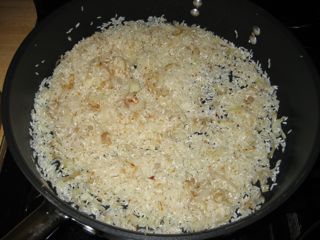
I heated some chicken fat (you do have chicken fat in the fridge, don’t you?) in a large pan, added chopped shallots and garlic, and sauteed until the shallots just browned, then added the rice and stirred for a few minutes:
I added a quart of the broth to the rice and tossed in the tops of the scallions I chopped for garnish – that’s what the Singapore chef did. (Extra flavor, no part of the scallion wasted, FTW!) After 20 minutes covered on low heat, the rice was done:
While the rice cooked, I turned my attention to the chicken. In only five minues I was able to shred this:
into this:
I tossed the shredded chicken with a few tablespoons of sesame oil.
In his video, Bittman makes a sauce out of oil, shallots, and garlic. In his book, he recommends a chile-ginger sauce. I’ve made the chile-ginger sauce before, but I didn’t have any fresh chiles, so I improvised a close approximation by adding grated fresh ginger and lime juice to bottled sriracha sauce (you do have sriracha sauce in your pantry, don’t you?).
The chicken was served on top of the rice, garnished with chopped scallions, with the chile-ginger sauce and dark soy sauce passed on the side. Here’s my plate (note the use of the macro lens):
I love the way this tastes, it’s all contrasts: cold chicken against warm rice, salty soy against pungent chile and ginger, crunchy scallions against soft chicken. Di and I could eat this every week, but I think Miles would object. But there’s an extra benefit from this recipe apart from leftovers. Bittman notes in his article:
While this is the most basic version, the best one is the provenance of devotees, who save the stock they don’t need for the rice, freeze it, and use it as a starting point for the next time they cook chicken this way. If you do this repeatedly, the stock will become stronger and stronger, as will the flavors of both chicken and rice.
As long as you remember not to salt the chicken if you’re using reserved stock, this technique is the way to go.
But wait, there’s more!
Bonus recipe: Dumpling noodle soup
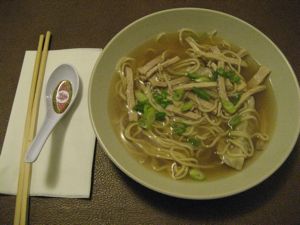
I read about this on Serious Eats. Instead of making awful ramen noodle soup according to the package directions, substitute chicken stock for water, add some ginger and garlic, and simmer for 15 minutes. Then add the ramen noodles and a few frozen dumplings (you do have… oh, never mind), simmer for five more minutes, and you get a hearty soup.
I skip the ramen pack altogether. I use leftover Hainan chicken stock, ramen noodles from the Asian grocery, and gyoza from Trader Joe’s. The whole dish comes together in 20 minutes:
I had some leftover roast pork, which I julienned and tossed in with the noodles and dumplings.
I have a friend who used to live on ramen soup. She described to me how she would try to introduce variations by adding different spices, but was most proud of the “bachelor soup” variation, which called for adding a cut-up hot dog to the soup as it simmered. Because she’s not dead from sodium poisoning, I plan to serve – and teach – her this new recipe.
Last night I spent two hours on the phone with a potential client reviewing his ideas for the redesign of his web site. It’s not an overly ambitious plan, but there are quite a few pages that will need to be created. I estimate the final site will incorporate somewhere between 25 and 30 pages.
I will have to implement a PayPal shopping cart, a live blog feed, podcast audio, videos, and a signup form for his mailing list. He’s also working with a designer who will be providing the graphic elements for the new design. This is all work that I have done before, no learning curve will be required for any of these elements, but it will still take a significant amount of time to build the site.
Eventually the conversation circled around to what I would charge for the work. I named my high price, he came back with his lowball price, and I suggested we split the difference. He’s still thinking about it. I also advised him that the middle-ground price would require him to provide me with all of the page content in final form, no post-construction editing would be allowed, since it’s a time-eater.
It disappoints me every time I have to go through this ritual. I had thought that by now we had moved past the “My nephew can do that work for $100” negotiating strategy. (Many of my current clients were directed to me after their nephews had made a hash of their e-commerce sites.) I still get asked to provide possible design ideas on spec: “Show us a few sketches of how the pages would look, then we’ll make a decision.”
I don’t design on spec. Very few web designers do. Zeffrey Zeldman drew the line in the sand almost five years ago, and I still adhere to his advice.
A less polite, but still relevant, perspective is provided by my pal Harlan Ellison in the documentary Dreams with Sharp Teeth – just substitute “designer” for “writer”:
You go, Harlan! At least I get stuff sent to me from some of my clients.
On the advice of my trained attack attorney (Diane), I need to state this blog’s policy about publishing recipes.
Recipes that I write about come from many sources: cookbooks, newspapers, magazines, online, and from my own collection.
I will often describe the steps in recipes, but without specific measurements or details. As long as a recipe is from a cookbook or other print source, I can’t list the complete recipe without violating copyright law. Should any of those sources have a legitimate online version, I will link to it. If not, you’ll have to find the source yourself.
Heh, come over here, kid, learn something. You never know, you might have to cook for twenty guys someday. You see, you start out with a little bit of oil. Then you fry some garlic. Then you throw in some tomatoes, tomato paste, you fry it; ya make sure it doesn’t stick. You get it to a boil; you shove in all your sausage and your meatballs; heh?… And a little bit o’ wine. An’ a little bit o’ sugar, and that’s my trick.
— Clemenza, in The Godfather
“I’ll show you the family tomato sauce recipe, but it will taste different when you make it back at school.”
— Mom
It was the summer after my sophomore year at MIT, and I had decided it was time to learn how to cook. Who better to learn from than Mom, and what better recipe to start with than the tomato sauce recipe that had been in the family for at least three generations.
It’s an idiot-simple procedure, unlike Clemenza’s recipe for boiled beef:
Brown some sausage, beef, and pork in a pot.
Pass two large cans of plum tomatoes through a strainer, discard the pulp and seeds, add the resulting puree to the pot.
Add one large canful of water and two cans of tomato paste, stir.
Add a few whole garlic cloves, and about a cup of red wine.
Simmer over low heat until thickened to the desired consistency, adjust seasoning with salt and pepper.
The most important step in the recipe, Mom warned, was preparing the tomatoes. You had to use canned, whole, peeled plum tomatoes and pass them through a strainer. The pulp and seeds, if added to the sauce, would make it bitter. Using tomato puree was forbidden, as was tossing the whole tomatoes in a blender (making your own puree), since both incorporated the bitter components.
For the next fifteen years I dutifully followed the recipe to the letter, cursing every time I had to haul out the wire strainer to crush the tomatoes. I would invariably wind up with a sore arm and scraped knuckles, but the sauce was always worth it.
Then I discovered this in the local Italian grocery:
Parmalat of Italy had heard my complaints, and had rewarded me with pre-strained tomatoes in a box! No more bruised knuckles, and, as an added benefit, I no longer had to add tomato paste – the boxed tomatoes created a thicker starting base to which I just had to add a little water.
The sauce did taste a little different, but I was willing to trade of the diference in tase for the sigificantly reduced effort required to make it.
Yesterday I had a “why didn’t I think of this before?” moment. I finally managed to connect a few facts together:
Mario Batali has asserted that imported canned San Marzano tomatoes are as good as, if not better than, fresh. I always keep a few cans in the pantry for use in other non-sauce recipes.
At the end of every summer, I buy 10-20 pounds of roma tomatoes from the farmer’s market and cook them to make a simple sauce that I put up in jars for the winter. I pass the cooked tomatoes through a food mill to separate the skins, seeds, and pulp.
It took two years for those two idea particles to colide and generate the obvious conclusion: Use the food mill instead of your hands and a strainer to separate the canned tomatoes for the sauce recipe.
Time to revisit mom’s original procedure. Here’s what I started with:
From left to right, back to front: red wine (Charles "3-buck Chuck" Shaw Cabernet), 2 cans Cento tomato paste, one can of whole peeled SanMarzano tomatoes, one can of diced, two pieces of beef blade steak, three cloves of garlic, and six pieces of sweet Italian sausage.
I filmed the bottom of a small stock pot on medium heat with olive oil, then added the meat to brown on both sides:
While the meat browned, I passed the tomatoes through the food mill:
The diced tomatoes were much easier to work with; the whole tomatoes had to be broken up to keep them from just rolling around in the mill.
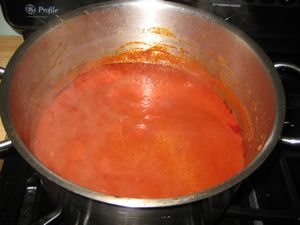
Tomatoes, paste, wine, garlic, and a large canful of water were added, along with a generous pinch of salt and black pepper. The pot simmered for three hours. (That’s why the extra water is added – the long simmer is necessary to absorb the meat flavors, but the sauce would get too thick if not diluted first.) Here’s the end result:
The photo doesn’t do it justice, but this sauce was as close to Mom’s in taste as I can ever remember. It was brighter, more acidic, with a much more pronounced tomato flavor. I attribute the difference to how the boxed tomatoes are processed. All shelf-stable products are UHT (ultra high temperature) pasteurized, which cooks the contents more than simple canning. (Parmalat UHT milk has a slight caramel undertone, from the heat degradation of the milk sugars.)
Mom’s sauce is a bit sweeter, but I already know the fix for that: add a piece of pork to the meat at the browning step. In her neighborhood you can find “sauce mix” at the supermarket meat counter: a half-pound chunk each of beef and pork, and a few sausages. I’ll have to check a few neighborhood markets around here for something similar.
I have this liquid love stashed away in the fridge for a few pasta dinners this week.
The Magic Spoon Theory
I am certain that if I used the same meat, same tomatoes, and the same wine that Mom uses, and replicated her measurements of wine, water, and garlic exactly, that my sauce would still not taste the same as hers. After years of thinking about this anomaly, I have come up with the only reasonable explanation, the only variable over which I have no control: Mom’s sauce spoon.
Mom has, as I have, a wooden spoon that she uses only for stirring the sauce. It’s as old as I am, misshapen at the edge, and almost black from decades of scraping and oil absorption. My spoon looks like this:
It’s only ten years old, but you can see how the edge is no longer symmetrical, worn down from years of scraping the pot bottom.
It’s Mom’s spoon that adds the final flavor to the sauce. I imagine that much in the same way the pioneers traveled across the great plains to settle the west, bringing their sourdough starers with them, the great wave of Italian immigrants brought their sauce spoons with them in the hope that they would be able to recreate the tastes of home.
I have explained the magic spoon theory to Mom, and while it makes her laugh, she won’t discount it completely. When I was visiting over the holidays, watching her make sauce in her tiny kitchen, she told me that she was leaving the spoon to me in her will. That’s a tacit confirmation of my theory, isn’t it?
As a parent of a child with Asperger’s syndrome, I pay particular attention to the debate over whether vaccinations cause autism – an issue that has been settled scientifically time and time again. (Short answer: Vaccines don’t cause autism.)
The debate is emotionally charged – what parent wouldn’t want to find a root cause for his child’s difficulties? Photos of autistic children, and their stories, feature prominently in media coverage. It’s emotional blackmail meant to sway public perceptions, and, unfortunately, it works.
I speak up against the vaccine hypothesis whenever it is mentioned to me, but I’ve found a new resource in the What’s the Harm? web site. Their mission is summed up neatly:
This site is designed to make a point about the danger of not thinking critically. Namely that you can easily be injured or killed by neglecting this important skill. We have collected the stories of over 225,000 people who have been injured or killed as a result of someone not thinking critically.
In the same way I direct people to snopes.com to debunk urban legends and chain-letter emails, I will now be directing people to What’s the Harm? to debunk “scientific” claims founded in poor critical thinking. The site isn’t just a collection of facts, it’s a collection of stories about victims of failures to think.
Here are a few direct links dealing with autism and vaccines:
Autism Blog, a UK-based clearinghouse for scientific and political news about autism.
Neurodiversity Weblog, which covers the status of lawsuits brought against vaccine manufacturers.
During his campaign, our president elect caved to popular opinion and made statements suggesting that the autism/vaccination link required “further study.” Fortunately he now has more pressing issues that will keep him occupied for a while. But the issue won’t go away. Do some reading, arm yourself with some facts.
Be very, very careful what you put into that head, because you will never, ever get it out.
— Thomas Cardinal Wolsey (1471-1530)