Food courts are awful. They always have the same collection of eateries you have only ever seen in other food courts, usually with food dumbed down for average American tastes. One afternoon I accepted a sample of chicken from each of three vendors, only to discover that the chicken teriyaki, bourbon chicken, and chicken curry all tasted the same.
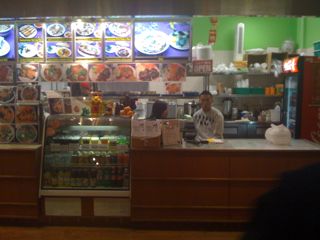
Boston has one exception to this sad state of affairs, located at the far end of Commonwealth Avenue near the Allston border: the food court at the Super 88 Asian Supermarket. The 88 is a subject for a post of it’s own, but its front is wrapped with a series of food stalls reminiscent of the hawker centers in Singapore. You can eat Thai, Korean, Japanese, Chinese, Taiwanese, and even Indian food, yet I always gravitate to Pho Viet, some of the best and most inexpensive Vietnamese food I’ve eaten.
I usually have a huge bowl of the pho dac biet: “special beef noodle soup with slices of rare steak, well done flank, brisket, tendon &Â tripe.” It comes with a side of bean sprouts, Asian basil, green chiles, and lime, all of which I dump into the bowl. It’s perfect on a freezing winter day.
I’ve lost count of how many times I’ve had the soup, so tonight I decided to try something different, which seemed to be the next most popular item on the menu – grilled short ribs with steamed rice:
Thin cross-cut short ribs, marinated in a sweet soy glaze, are grilled to crisp the edges and served over simple steamed short-grain rice. Enough of the glaze drips off the ribs to infuse the rice, but I added some more soy to cut some of the sweetness. There’s a salad of cucumber, lettuce, and pickled carrots and radish (and some sad winter tomato slices, the only off note). It may not look like much in its foam takeout box (the only dishes for eating in are the pho bowls), but it had the perfect balance of sweet, sour, and spicy. There’s also the great tactile component of having to pick up each piece to tear the meat off the little bones.
Another ideal winter evening meal. Add a citrus honey boba tea from the Lollicup stall to the right, and you get a full dinner for only ten bucks. If the place was any closer I’d probably eat there once a week.
I never really thought about it, but Trader Joe’s doesn’t advertise. The closest they get is the occasional Fantastic Flyer they send in the mail if you joined their list.
An enterprising fellow with a Palm Treo remedied this deficiency by creating a Trader Joe’s commercial from footage shot on his Palm Treo. It’s very clever, but the song he wrote to accompany it is amazing.
… and they’ve been out of frozen Tarte d’Alsace for months.
With a few exceptions, most of my cooking effort is channeled into preparing dinners. Weekends are reserved for more time-consuming recipes, while weekdays are for quicker or simpler fare. When possible, I try to cook enough to get two meals out of one cooking session – the gumbo will show up at the table again this week, as will the last of the pasta and sauce.
I noticed that four of the recipes I’ve posted in the brief five weeks this blog has been in existence have consisted of “something in a bowl with scallions and/or rice.” There’s also been a skew toward Asian recipes. The trend is partly seasonal (heartier fare in the winter), partly a result of what I’m currently interested in cooking or learning about, and partly a concession to He Who Must Not Be Ignored – my picky 9-year-old resident food critic.
I want a better idea of what my weekly meal planning looks like over the course of a year. Am I leaning too heavily on a sure-fire repertoire? What are the seasonal cycles?
I realized I could answer these questions and learn a new web technique at the same time. I created a Twitter account for reporting what I cooked for dinner, and added a sidebar “What’s for dinner?” widget to track the ten most recent entries. I’ll wind up with a log of the year’s meals, and you’ll see a slowly changing snapshot of my unglamorous kitchen activity.
I work at home, in an office on the top floor of my house. I listen to music non-stop while I work, but from January 3, 2006 to March 2, 2007, I listened to a radio talk show.
Penn Jillette, of Penn and Teller, hosted Penn Radio every weekday afternoon during that year and a third. He and I are friends, but I don’t get to talk to him much since he relocated to Las Vegas, so listening to the show was a way to keep in touch. I even called in a few times to answer a question he asked on the air (sometimes I’m faster than Google).
After a few months, the show developed some semi-regular themes, one of which was Monkey Tuesday, a feature so popular it had its own Wikipedia entry. Listeners would call in and tell funny stories involving monkeys (or other primates).
Recently, while working with a client to post his Penn Radio podcast appearances, I located my own call-in Monkey Tuesday story. It’s from October 3, 2006, and is about an incident that occurred when I worked at an alcohol and drug abuse research center:
The day after I told the story, I was forwarded this email from co-host Michael Goudeau:
Hello Penn and Michael,
I just learned about your show a couple weeks ago through a friend and I have been listening to about 4 shows a day via podcast. I work in Scranton, PA at a Christmas card design company, but my real passion is horror illustration. Needless to say, your show helps me get through the daily onslaught of Nativity scenes, snowmen and that damned St. Nicholaus.
I listened to your show LIVE for the first time today and was inspired by the drunken rat/coke-head monkey story. The image I’m sending you was sketched out on a stickie note immediately after I heard that hilarious tale.
Keep up the great work. Your show is fantastic!
Joe ——–
Horror Illustrator
Monkey Tuesday Junkie
This is the attached sketch:
Joe’s talent is wasted on holiday cards. I’m happy to have given him an opportunity to express his twisted inner self.
Every now and then, I still find myself saying “It’s Monkey Tuesday!”
Before he became the catchphrase-shouting, product-shilling Ewok-like face of the Food Network, Emeril Lagasse was television chef who made good food. I still refer to his Every Day’s A Party cookbook when I’m looking for something new to try.
I’ve cooked his Gumbo Ya Ya – chicken and sausage gumbo – many times; but have become dissatisfied with the taste. The roux is too dark, lending too much of a smoky/burnt note to the final dish. After watching the “Bowl o’ Bayou” episode of Good Eats last week, I decided to try a hybrid of Emeril’s recipe and Alton Brown’s shrimp gumbo recipe.
I began with the first steps in Emeril’s recipe, stewing the chicken:
I placed a fowl (a large, old, tough chicken, about 7 pounds) into a pot with 2 quartered onions, 2 stalks of celery, a bay leaf, a tablespoon of salt, and 3 quarts of water. I brought the water to a boil, reduced the heat to medium, partially covered the pot, and let everything simmer for 2 hours. I had already deviated from the recipe at this stage: Emeril calls for 2 quarts of water, which isn’t enough to cover the fowl, so I upped the amount to 3 quarts. I also omitted the cayenne pepper. I knew I’d have more broth than I needed after this step, and it’s difficult to use spicy stock in most dishes I make.
While the fowl simmered, I turned my attention to making the roux. Emeril calls for 1 1/2 cups each of oil and flour, stirred together on the stove for 20 to 25 minutes until it turns dark brown. No matter how much I lowered the heat during this step in previous preparations, the roux was always dangerously close to burning in about 15 minutes. Here’s where I introduced Alton’s method. I mixed the oil and flour together in a large dutch oven:
The pot went into the oven set to 350°, and was stirred every 30 minutes for 90 minutes. While the roux cooked, I prepped the rest of the ingredients:
When the fowl was done I removed it and set it aside to cool. I strained the stock and reserved 2 quarts. The rest I saved for later (foreshadowing – the key to a good recipe).
The roux came out of the oven, a bit lighter than Emeril’s preferred doneness:
I added the reserved stock, stirred to combine, and let the mixture simmer uncovered on medium-low heat for 90 minutes.
While the gumbo simmered I pulled the fowl apart, discarded the skin, shredded the meat, and reserved the bones. I chopped the shredded meat into smaller pieces, then browned the sliced andouille:
During the final gumbo simmer I made the rice from another Alton recipe: cook 2 cups of basmati rice in 2 tablespoons of butter for 3 minutes over medium heat. Add 3 cups of boiling water and 1 teaspoon of salt, stir to combine, cover, and cook over low heat for 20 minutes.
Final plating: a hefty spoonful of rice in a bowl, ladle the gumbo over, and garnish with parsley and scallions:
Oh mais oui, this was the best batch I’ve made. The flavors were more balanced, not dominated by the roux. The garlic and thyme added some depth and the reduced cayenne provided some afterburn without wiping out the taste of the andouille. And, of course, it tasted all the better while watching the Steelers win. Laissez les bon temps roulez!
A cooking tip
Knowing I was going to wind up with a pile of bones and meat scraps from the cooked fowl, I decided to make a batch of chicken stock. I thawed out my stash of frozen chicken backs and wings (leftovers from previous chicken preps), then chopped everything in half. This is a key step: chopping exposes the bones, which releases more collagen into the stock. I browned the pieces with a little oil, a chopped onion, a chopped carrot, and a few celery stalks (use the little bits from the middle of the celery hearts; the leaves add more flavor to the stock).
I added the reserved stock from the gumbo prep, tossed in the fowl bones and scraps (See? Foreshadowing!), some salt and a bay leaf, and then water to almost fill the pot. I let this simmer over very low heat for three hours:
I strained it, cooled it down, and portioned it out into quart-sized containers, which now reside happily in my freezer.
… and a snack
When I made char siu pork, I got to the step where I had to trim off the skin from the pork belly after it had marinated for two days. I didn’t want to throw it away, but I also didn’t know what to do with it. While pulling together the munchies for yesterday’s Super Bowl viewing, it hit me: pork rinds.
I cut the skins into bite-sized pieces:
Then I gave them a quick dunk in hot oil. I removed and drained the puffed up skins:
Behold, five-spiced pork rinds! (They’re not burned, that’s the caramelized sugar from the marinade.) Sweet, salty, crunchy, and with a hint of soy and hoisin.
After graduating from NYU, Chris got a job at Greene Street Studio, where he had interned as an undergraduate in the music and recording program. (Greene Street used to be Big Apple Studios, where the famous No New York compilation was recorded.) Greene Street’s owner, Steve Loeb, was also the manager and producer for Riot, a metal band formed in 1977. Steve had been releasing Riot records on his own Fire Sign Records label for years.
Whenever I would go to New York to visit my family, I would try to meet up with Chris at the studio, both to hear what he was working on, and to watch him work. One of these visits led to a disaster with my then-fiancee, whom I had dragged to the studio to meet Chris. On that particular evening, he was fine-tuning bass drum sounds, so She Who Must Not Be Named got to spend an hour listening to thud thud thud before demanding to leave. I indelicately suggested that what Chris was doing was no more boring than her tales of life as an insurance actuary, and that was the beginning of our end.
When I met Diane, I arranged obligatory “meet my family” visits. I knew that eventually she would want to see Chris at work. I agreed to take her to Greene Street, but warned her about the possibility of a boredom-inducing bass drum session. Undeterred, Di still wanted to see Chris in action.
I had called ahead to let Chris know we’d be dropping in, but had failed to ask what he was working on that night. When we arrived, the studio was running at full tilt: people everywhere, both recording suites busy, instruments being shuffled in and out of rooms. Chris waved us over to the mixing desk, handed us both a set of headphones, and pushed us into a vocal booth with the rest of Riot, who were working on their new record.
Once we had settled down, Steve said “We’re laying down some backing vocals for this song’s chorus. When I give you the cue, just shout ‘little miss death’ into this microphone. Be sure to over-articulate, or it will sound like sludge.” After a quick playback of the track for tempo, we shouted our line a few times, then were unceremoniously chased out of the booth with a “good job, thanks, later.”
We stuck around to watch Chris shape a rough mix of the track, and then promptly forgot about it until he sent us a cassette of the song a few weeks later. It would be included on the record, to be titled The Privilege of Power.
The band is still a going concern, and their records are still in print. So, for your listening pleasure, I present “Little Miss Death”:
My most vivid memory of my Italian grandmother – my mother’s mother – is watching her make pasta. She had a board and rolling pin she used to roll out paper-thin pasta dough, which she would then cut into different shapes. Once I saw her make cavatelli, little tightly-wound shells, by dragging her fingertips across the dough and flicking the pasta off to the side, all in one motion.
Mom used to cut her own lasagna and fettucine until someone gave her a “pasta machine,” a hand-cranked device with two adjustable-width rollers and a feed hopper. Push dough through one end while you cranked, and long thin sheets came out the other. Other rollers with cutters could be added to make thinner strands, all the way down to spaghetti. If you got tired of cranking, you could buy an electric motor to attach to the crankshaft. I have a similar setup that attaches to the end of my KitchenAid mixer.
If you want any kind of shaped or tubular pasta, you need a pasta maker, which, technically, is a pasta machine, but I’m not going to argue the nomenclature. Someone gave Mom a pasta maker, which she passed on to me, as she had no interest in making “fancy pasta.”
Since I had just made a batch of sauce last week, I thought I’d give the pasta maker a spin. Usually I make pasta dough from semolina flour, which requires hours of resting before it can be used, and is very finicky to work with. This time I decided to consult with my expert, Albert Capone (yes, he’s Al Capone) of Capone Foods, just a short walk from my home.
Al recommended a 00 grade high protein flour that he imports from Naples. He told me that semolina should only be used in high-output pasta makers with brass dies, since the semolina grains will eventually abrade the teflon dies found in home machines. The only other component to the dough is eggs, about four large eggs per pound of flour.
I miked the floyur and eggs in the pasta maker, adjusted the consistency with a tablespoon or two of flour, then attached a die (Miles chose the conchiglie rigati, or small shells) and started extruding:
I cut the pasta as it extruded, taking about 20 minutes to go through the full pound of pasta dough. Here’s what I wound up with:
I cooked half of the shells for 3 minutes, which produced perfect al dente pasta. After a quick toss in some sauce we were ready to eat:
Just like Mom used to make.
I let the other half of the shells dry overnight so they could be stored without sticking together.
I’ve read that in this economy the pasta business is booming because it’s cheap. I have nothing against the stuff in the box, but I’ll be making a lot more homemade pasta this year. It’s cheaper than the boxes, and tastes better. Besides, how often do I get to play with the adult version of a Play-Doh Fun Factory?
I’ve mentioned that I’m a sucker for music lists. I love collecting songs and albums that fit a particular classification, the more obscure, the better.
Most of these lists haven’t been too difficult to compile; in some cases it’s a simple matter of assembling music I already have into a new playlist, in others I have to make an effort to locate rare or obscure releases. More recently I have been able to find a version of the compilation that someone has already posted online, which is what I did with The Pitchfork 500 list.
Now I’ve turned my attention to the great white whale of music compilations: The Nurse With Wound List, a list of musicians and bands that accompanied Chance Meeting on a Dissecting Table of a Sewing Machine and an Umbrella, the first album by Nurse With Wound, released in 1979. The list was a cover graphic:
A more legible version of the list can be found at the Audion Guide Site, although there is now an online cottage industry devoted to analyzing the list. My usual mail order source of obscure sounds, Wayside Music, now has an entire subcategory devoted to the it.
Since the list was published in 1979, and consists only of the names of the artists, there is some room for interpretation of which albums are recommended. I’ve decided to stick to the Audio Guide version. A quick survey of all 294 entries showed that I currently have only 43 of the albums, a mere 15%.
My completing the list could take many years. I can’t afford to just buy everything all at once (what’s the fun in that?), and most of the albums are guaranteed to go into and out of print again and again. But it will be a background-level hobby for me. It has to be, I’m too old to be looking for another Holy Grail.
Diane’s sister Cathy and her family spent a year in Hawaii. Her husband, Ben, who is a painter, got a job laying mosaic tile. His co-workers introduced him to some of the local food favorites, including Spam musubi, a snack so ubiquitous it could be found at Seven-Elevens.
From what I’ve read, it’s a mashup of the island’s Japanese influences and post-WWII make-do economics. A lot of Spam was dumped on the island after the war rather than shipping it back to warehouses on the mainland. Cheap surplus Spam + rice + seaweed = tasty snack. After looking up a few recipe variations, I decided to give it a try.
Here’s the muse-en-place:
I made sushi rice, but didn’t add the sweet vinegar. I broke three sheets of nori into six halves. The sauce here is bottled teriyaki because I wanted to finish it off, but a half cup of sugar dissolved in a half cup of soy is preferred. The plastic gizmo is a musubi press, found online. Some recipes say to use the Spam can with the bottom cut off as a mold, but I figured the press was much cheaper than an emergency room visit.
Notice I’m using Spam Lite. I’m nothing if not health-conscious.
Lastly, the jar is furikake, a Japanese condiment meant to be sprinkled on rice. There is a baffling array of this stuff at my local market, so I chose the variety that had the most ingredients: dried and ground fish, sesame seeds, chopped seaweed, sugar, salt, MSG, shiso, and egg.
I uncanned the Spam, listening for the schlorrk it makes as it escapes its gelatinous prison, then cut it into six slabs. The slabs went into a pan on medium heat and cooked until browned on both sides. Then I added the teriyaki and continued cooking until I had glazed Spam (Glazed Spam – good name for a band):
Time for assembly: I centered the mold on a sheet of nori, filled it with about a quarter cup of the rice, then compressed it with the plunger. Next was a heavy sprinkle of furikake:
I added a Spam slab, then more rice, and compressed it all again:
I wrapped the nori around this rice and Spam brick, and sealed the edges with a few stray rice grains. After making the first one, the rest followed pretty quickly:
I ate one while it was still warm from the rice. It was very filling, very salty, and very tasty. I can see the lunchtime appeal of this snack. I wrapped the rest tightly in plastic wrap; I’ll re-crisp them in a pan when I need a respite from my usual lunchtime sandwich.